PARTICLE SIMULATOR (2026)
Particle Simulator is an art instrument: a sort of meditation on human interactions with unstable natural and algorithmic processes, and the emergence of complexity from self-referential systems (à la assembly theory, loosely). It uses digital synthesis and processing to create an unpredictable, dynamic, and nuanced interactive experience—inviting the human interactee to listen carefully and embrace its volatile processes, influencing its direction and developing an evolving sensitivity to its behavior along the way.
Compact Impulse Generator + Retention Mechanism
It is composed of two principal sections: a Compact Impulse Generator, and a Retention Mechanism. Compact Impulse Generator is its core sound and control generation structure. It draws inspiration from pulsar synthesis, Buchla-style "complex oscillators," and unstable instruments such as Hordijk's Blippoo Box. By utilizing a combination of peculiar waveshaping, frequency modulation, partly inscrutable macro control structures, continuous internal control (re)routing, stochastic processes, and modulation feedback, it readily manifests spontaneous and unusual parametric couplings—producing clean Curtis Roads-esque pulse trains that devolve into fizzing, crackling, sputtering, discontinuous textures.
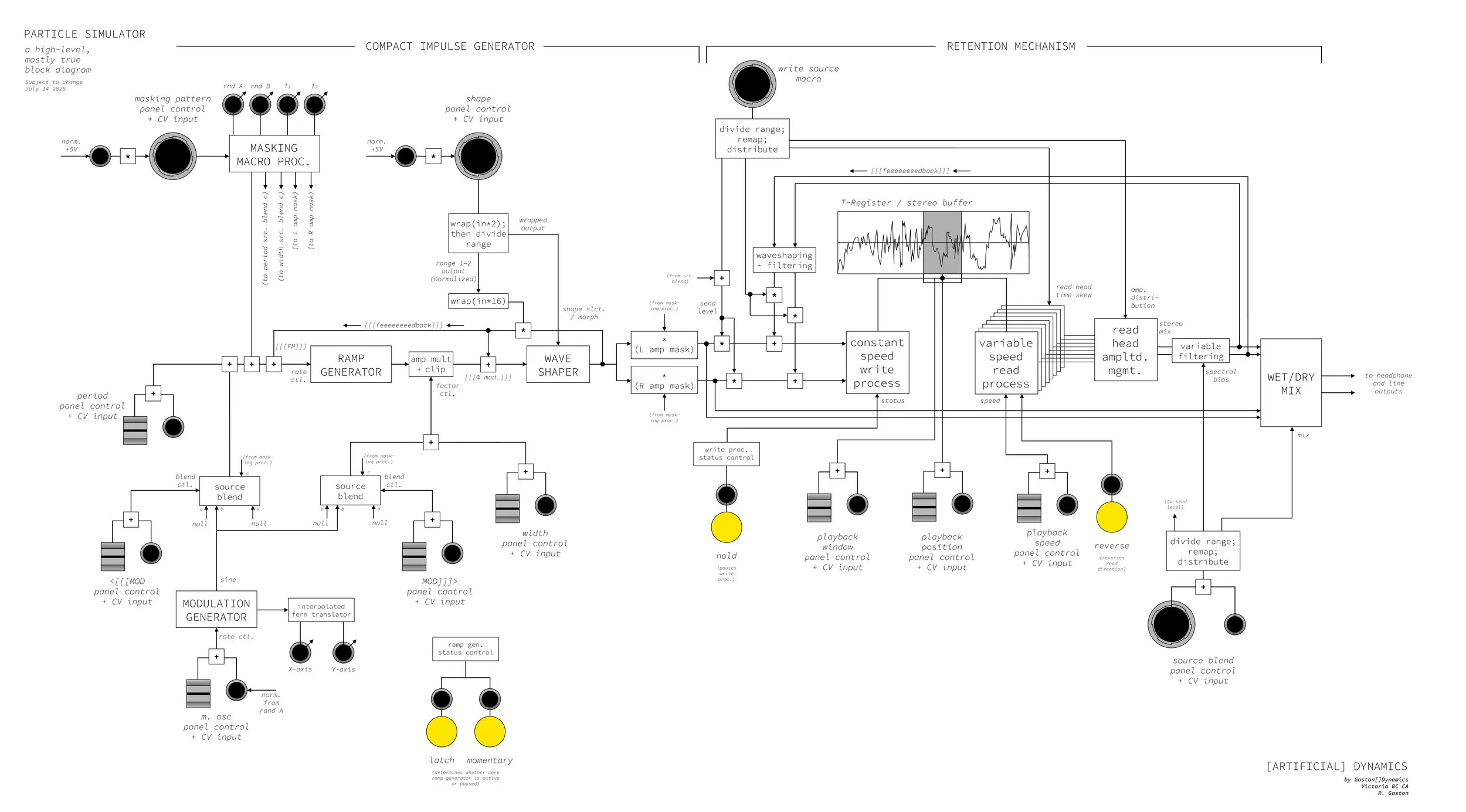
Retention Mechanism is an integrated audio processor. It rethinks the typical implementation of audio delay effects, allowing techniques such as comb filtering, flanging, multi-tap echoes, pitch shifting, and granular sampling. By sidestepping the typical compulsion to optimize for any of these specific behaviors, it brings many typically-hidden artifacts of these processes to the forefront; indeed, these "suboptimal" behaviors become definitive aspects of its character. Jitter, downsampling, clicks, pops, and odd windowing artifacts become a core part of its sonic identity. Commonly, Retention Mechanism is used to process or sample the sound generated by Compact Impulse Generator. However, Retention Mechanism can also self-oscillate, acting as a howling sound source of its own.
Retention Mechanism uses an arbitrarily traversable memory register at its core (T-Register). Rather than using the "circular buffer" or "variable sample rate" techniques used by many delay effects, it allows random access to any portion of the buffer at all times: often resulting in discontinuous collages of past material erratically re-emerging when modulation is applied.
The instrument is noisy, occasionally lo-fi, and designed to exploit the idiosyncrasies of "poorly optimized" digital synthesis and processing algorithms. Expect aliasing, jitter, and noise to be a part of its sonic palette.
Voltage Control
Core aspects of both the Compact Impulse Generator and Retention Mechanism are voltage-controllable; most CV inputs feature dedicated attenuators or attenuverters. The Compact Impulse Generator also features several control voltage outputs: two continuous outputs derived from an interpolated alteration of a classic fractal fern drawing algorithm, as well as two stepped random voltage outputs and two trigger outputs derived from the Impulse Generator's Masking Pattern macro control algorithm(s). These outputs may be used to dynamically alter any voltage-controllable aspect of the device's behavior.
Form Factor + Technical Details
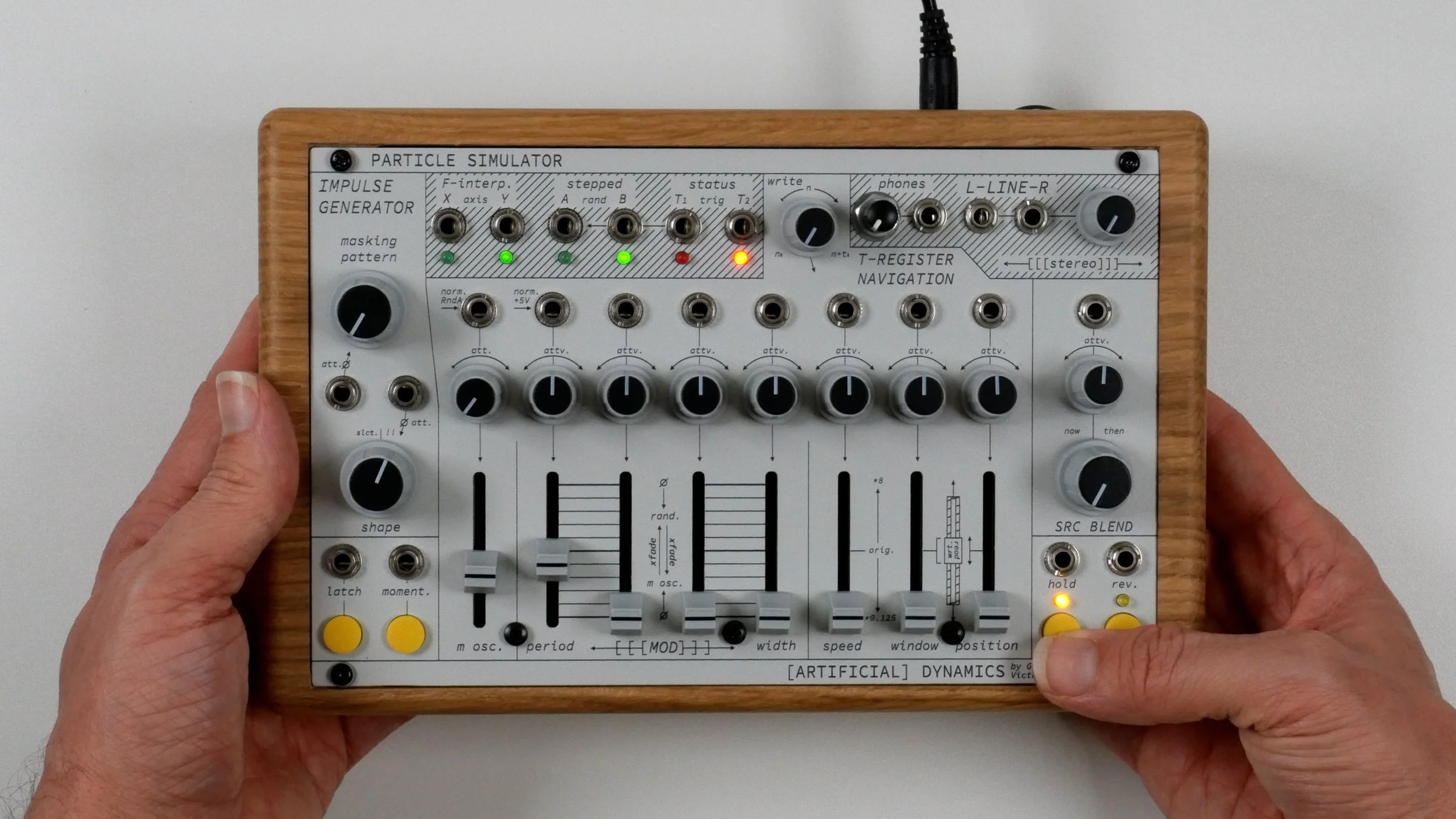
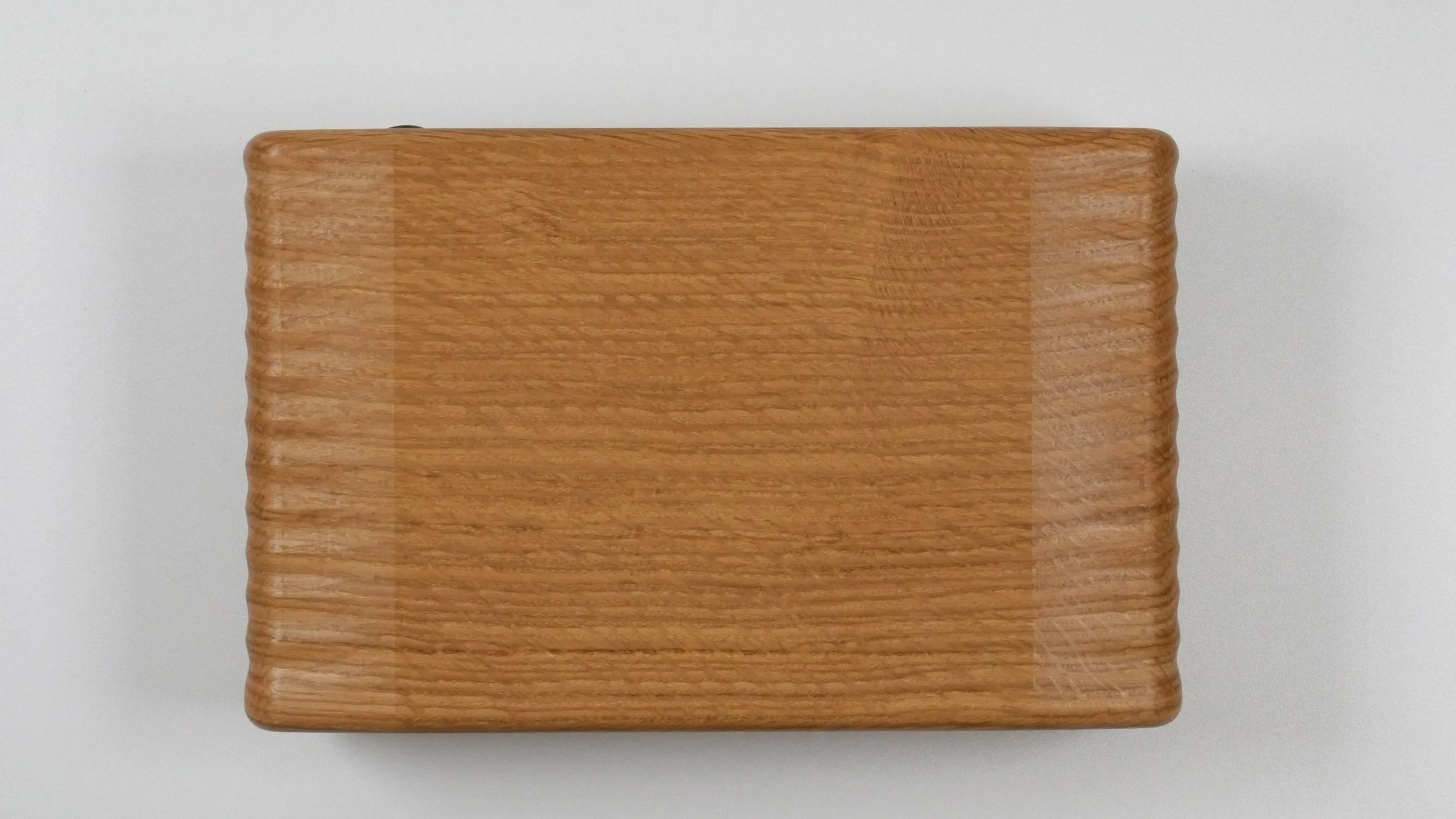
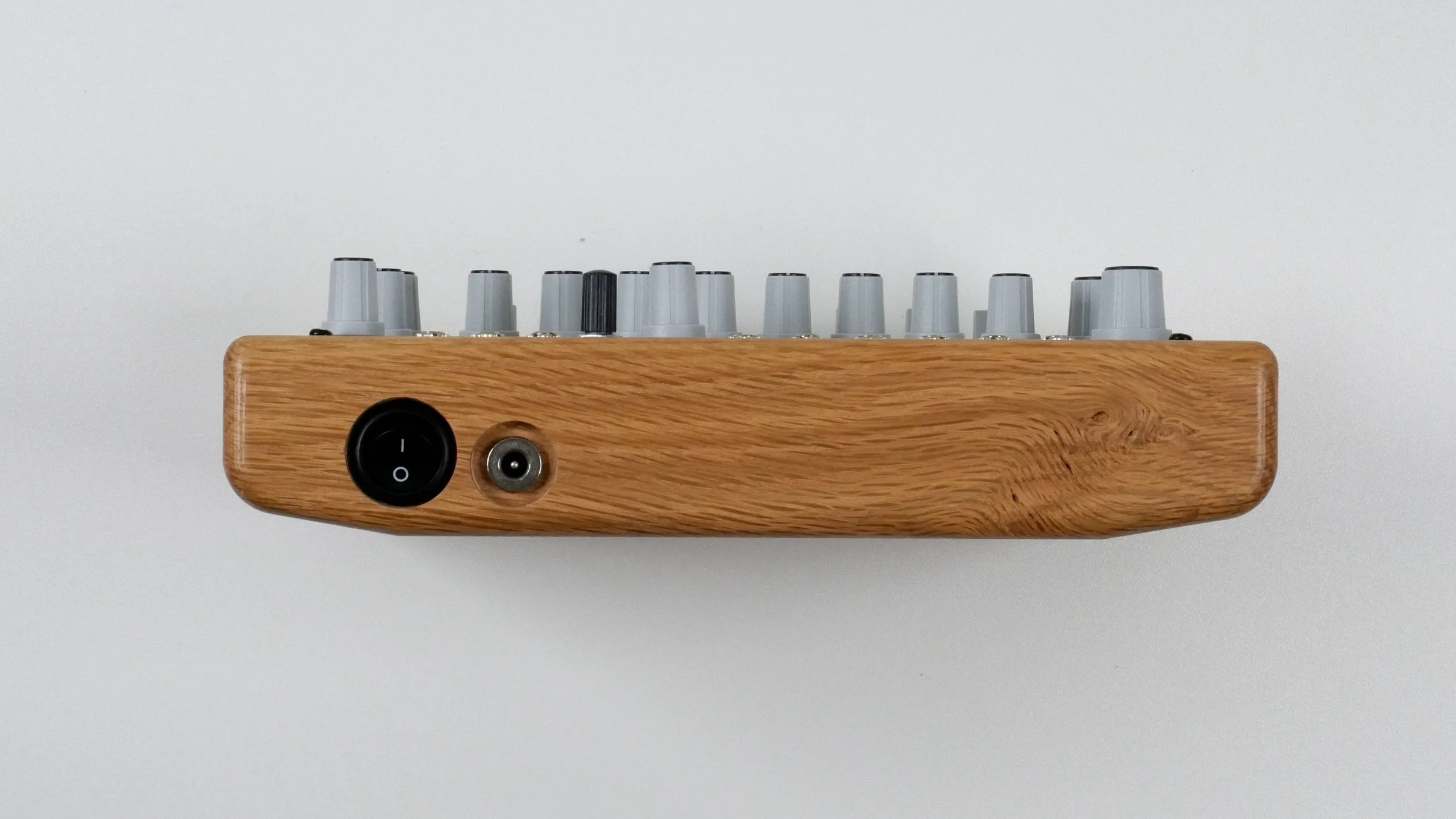
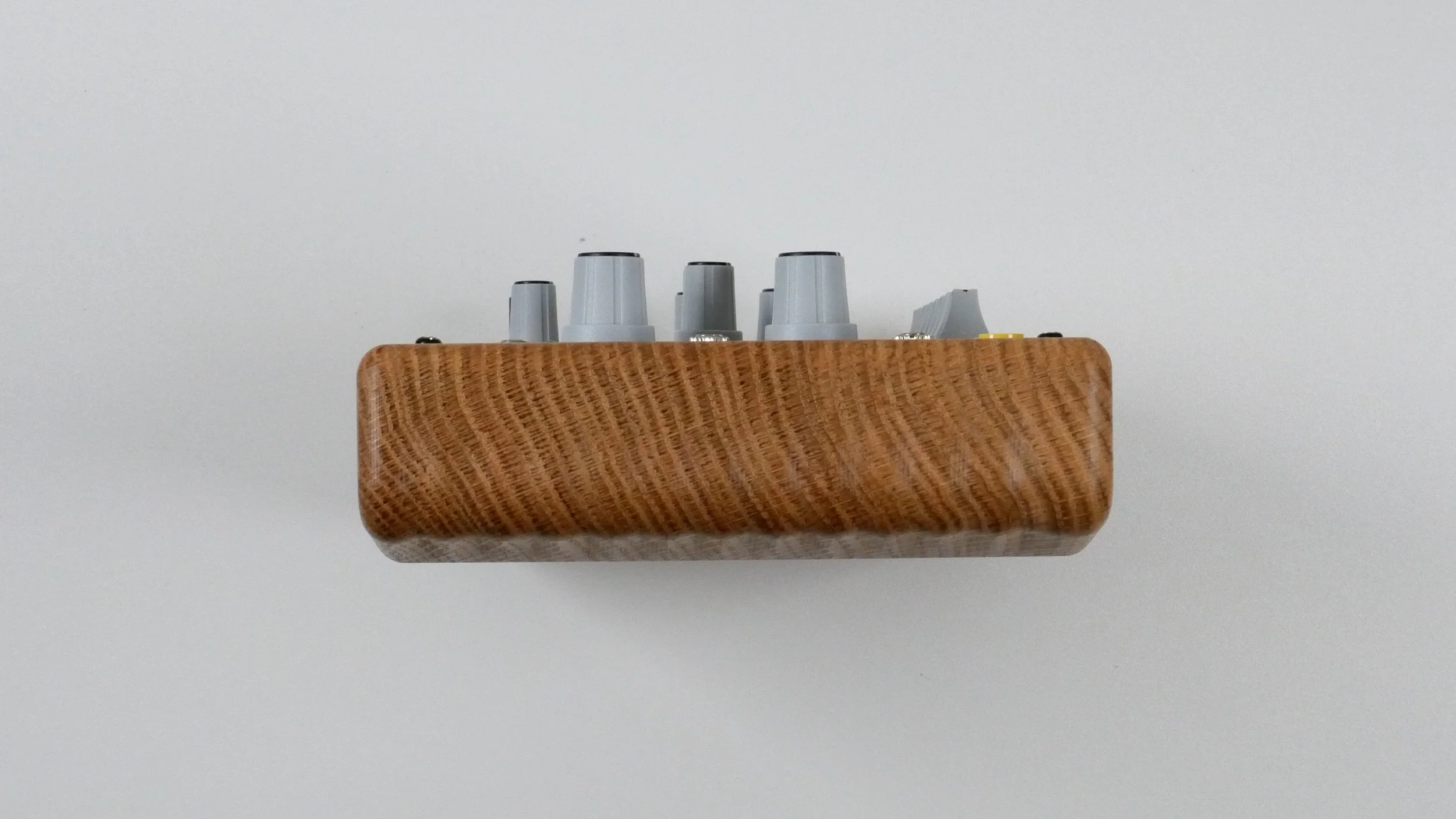
Particle Simulator is a standalone instrument. Its enclosure is made from a single piece of milled hardwood, designed and crafted by Vincent Edwards in Fayetteville, Arkansas. The bottom of the enclosure features contoured edges with a rippled pattern—allowing easier "grip" for handheld use. Indeed, handheld use is strongly encouraged: it was designed such that it is light enough for most two-handed users to hold in one or both hands, with most key parameter controls reachable via the thumb and index finger of either the left or right hand. Particle Simulator has been assembled with enclosures made from white oak, walnut, and padauk.
The panel is produced in Canada, featuring a light gray powder coat, with a subtle sand texture. It utilizes custom Selco knobs and slider caps, as well as Thonkiconn jacks, Alpha and Bourns potentiometers, and other high-quality components. Particle Simulator’s dimensions are roughly 9” x 6” x 2.5”. The weight is roughly 1.7lbs.
Particle Simulator prototyped beginning in the summer of 2025. The initial prototype was assembled on September 8, 2025; subsequently, four additional prototypes were built, with prototyping completed in Spring of 2026. An edition of twelve additional units was assembled in Spring/Summer 2026; a subsequent small run is planned for late summer/early fall 2026.
Particle Simulator is unlikely to be produced again in the future; but do feel free to reach out for further information about its functionality and production status.